• Homepage Design Best Practices: 7 Questions Your Homepage Must Answer

    Homepage Design Best Practices: 7 Questions Your Homepage Must Answer

    Your homepage is often the first impression people have of your business, and in many cases, it is the page that determines whether someone continues exploring your website or leaves within seconds. That is why homepage design best practices are about much more than creating a visually attractive layout. 

    A successful homepage should answer your visitors’ biggest questions immediately, reduce uncertainty, and make it easy for them to take the next step.

    Too many businesses invest heavily in advertising, SEO, or social media only to send visitors to a homepage that creates confusion instead of confidence. A homepage that is difficult to understand can become a barrier between your business and potential customers. On the other hand, one that communicates clearly can increase engagement, improve conversions, and strengthen your entire digital marketing strategy.

    Whether you are planning a complete website redesign or simply looking to improve your website design services, understanding homepage design best practices can help you build a homepage that works harder for your business.

    Instead of chasing design trends, focus on answering the questions every visitor is already asking the moment they arrive.

    Why Your Homepage Has One of the Most Important Jobs on Your Website

    People rarely visit a website just to admire the design. They arrive because they have a question, a challenge, or a goal they want to accomplish. They may be comparing companies, researching solutions, or looking for a business they feel confident contacting. Your homepage serves as the introduction that helps them decide if they have found the right place. If you are planning a complete redesign, our Website Redesign Checklist can help you prepare before making major changes.

    Users scan webpages rather than reading every word from top to bottom. They look for visual cues, headlines, and content that quickly tells them whether the page is relevant to their needs or not. If that information is missing or buried beneath vague marketing language, many visitors simply leave.

    This is why the best homepage design best practices prioritize clarity over creativity. Google also encourages businesses to create content that is helpful, clear, and designed primarily for people rather than search engines. A beautiful homepage is valuable, but only if it also communicates your message quickly and effectively. Every section should help visitors move closer to making a decision rather than forcing them to figure things out on their own.

    Question 1: What Does Your Company Actually Do?

    This may seem like an obvious question, yet it is one of the biggest reasons homepages fail. Many businesses know their services so well that they unintentionally write for themselves instead of writing for first-time visitors. Headlines become clever rather than clear, and people leave without fully understanding what the business offers.

    Your primary headline should explain what your company does in plain language. Visitors should not have to scroll, click through multiple pages, or interpret creative taglines to understand your services. If your homepage immediately explains what you do and who you help, you have already eliminated one of the biggest sources of friction.

    Supporting text beneath the headline should expand on that message by briefly explaining your expertise, your ideal audience, and the outcomes you help people achieve. One or two concise paragraphs often communicate far more effectively than several vague marketing statements

    Question 2: Is This Business Right for Me?

    Once visitors understand what you do, their next question is usually if your company is the right fit for their needs. People naturally look for signs that they have found a business that understands their challenges and has experience solving problems similar to theirs.

    One of the most effective homepage design best practices is speaking directly to your ideal audience instead of trying to appeal to everyone. Specific messaging makes people feel understood. Whether you specialize in healthcare, manufacturing, professional services, home services, or another industry, your homepage should clearly communicate who benefits most from working with you.

    The visuals you choose also contribute to this message. Authentic project photography, recognizable industries, and examples of your work help reinforce that visitors are in the right place. Many businesses are also using professionally produced videography in the hero section, to immediately communicate their brand, showcase their team, or demonstrate their work in action. When done well, these videos help visitors quickly understand what your company does while creating a more engaging first impression. When people see themselves reflected in your messaging, imagery, and video content, they are more likely to continue exploring your website.

    Question 3: Why Should Anyone Trust You?

    Trust is one of the biggest factors influencing buying decisions online. Visitors are naturally cautious because they have countless options available. Before contacting your company, they want reassurance that you have the knowledge, experience, and credibility to deliver on your promises.

    This is where trust signals become essential. Testimonials, case studies, recognizable client logos, awards, certifications, years of experience, and measurable business results all help reduce uncertainty. Rather than simply telling visitors you are experienced, show them proof that others have trusted your business and achieved positive outcomes.

    Building trust also means being transparent. Clearly explaining your process, introducing your team, and showcasing real examples of your work all contribute to a stronger first impression. The goal is to help visitors feel confident enough to take the next step.

    Question 4: What Makes You Different From Every Other Company?

    Many homepages rely on generic phrases like “innovative solutions,” “customer-focused,” or “results-driven.” While these statements sound positive, they do very little to help visitors understand what actually separates one business from another.

    Instead, explain what makes your approach unique. For example, we do not take the same approach with every client. A restoration company needs a website that communicates trust, fast response times, and technical expertise, while a manufacturing brand requires messaging that highlights product quality, project capabilities, and long-term reliability. Every homepage is built around the audience, industry, and business goals rather than using a one-size-fits-all template. That strategic approach helps create websites that are not only visually appealing but also more effective at generating qualified leads.

    The strongest homepage design best practices encourage businesses to replace broad claims with meaningful specifics. Real differentiation is memorable because it helps visitors understand why they should choose your company instead of the many alternatives available online.

    Question 5: What Should I Do Next?

    Even the most informative homepage can underperform if visitors are unsure what action to take next. Every homepage should guide users toward a logical next step based on where they are in their decision-making journey.

    Your primary call to action should be easy to find throughout the page. Whether your goal is scheduling a consultation, requesting a proposal, downloading a resource, or contacting your team, the next step should always feel obvious rather than hidden.

    Secondary calls to action can support visitors who are still researching. Some people may prefer reading case studies, exploring your services, or learning about your process before reaching out. Providing multiple paths while maintaining one primary objective creates a better user experience for different types of visitors.

    Question 6: Can Visitors Find Information Without Working for It?

    One of the biggest mistakes businesses make is trying to fit everything onto their homepage. More content does not automatically create more value. In fact, too much information often makes it harder for visitors to find what they actually need.

    A well-organized homepage guides users through information in a logical sequence. Start with a clear introduction, explain your services, establish credibility, highlight your process, showcase successful work, answer common questions, and finish with a strong call to action. This natural flow helps visitors build confidence as they continue scrolling.

    Good navigation also plays an important role. Visitors should always know where they are, what they can explore next, and how to contact your business. Simplicity almost always outperforms unnecessary complexity.

    Question 7: Does Your Homepage Perform Well on Mobile Devices?

    homepage design best practice

    Today, many people will experience your homepage on a smartphone before they ever see it on a desktop computer. A homepage that looks beautiful on a large screen but becomes frustrating on mobile creates unnecessary obstacles that can cost your business valuable opportunities.

    Responsive design goes beyond resizing images. Buttons should be large enough to tap comfortably, text should remain readable without zooming, forms should be easy to complete, and pages should load quickly even on slower mobile connections.

    Improving mobile usability benefits more than user experience. Search engines also consider page experience and mobile usability when evaluating websites, making mobile optimization an important part of a long-term digital strategy.

    Homepage Design Best Practices That Improve User Experience

    When evaluating your homepage, there are several principles that consistently contribute to better performance. These homepage design best practices help visitors understand your business more quickly while encouraging them to continue exploring your website.

    Start with a headline that immediately communicates what your company offers and who you help. Support that message with concise introductory copy that focuses on customer outcomes instead of internal company language. Use visual hierarchy to naturally guide attention toward your most important content, and avoid clutter that competes for attention.

    Include meaningful trust signals throughout the page instead of grouping them into a single section. Testimonials, client logos, certifications, and measurable results reinforce credibility as visitors continue reading. Finally, make sure every major section naturally leads toward your primary call to action without feeling overly promotional.

    Common Homepage Mistakes That Hurt Conversions

    Some homepage problems appear small but can have a significant impact on performance. One common mistake is leading with company history instead of customer value. Visitors generally care less about when your business was founded than they do about how you can help solve their current problem.

    Another frequent issue is relying too heavily on industry jargon. While internal terminology may make sense to your team, new visitors often prefer clear, conversational language that helps them quickly understand your services. Simplicity should never be mistaken for lack of expertise.

    Many businesses also overwhelm visitors with competing calls to action. If every button encourages a different action, people may struggle to decide what to do next. A focused homepage with one primary objective usually creates a much smoother experience.

    Why Great Homepage Design Supports Every Marketing Channel

    Your homepage does not exist in isolation. It supports nearly every digital marketing activity your business invests in, including SEO, paid advertising, email campaigns, social media, referral traffic, and direct visits.

    Imagine running a successful advertising campaign that brings thousands of qualified visitors to your website. If your homepage immediately creates confusion, much of that investment is wasted because people leave before learning about your services. Improving your homepage often increases the effectiveness of every marketing channel without increasing your advertising budget.

    Imagine running a successful SEO or paid advertising campaign that brings qualified visitors to your website. If your homepage immediately creates confusion, much of that investment is lost. We have seen this across industries. A brick manufacturer needs a homepage that quickly guides architects, builders, and contractors to the right products, while a home service company needs to help homeowners understand their problems and feel confident reaching out. In both cases, the homepage plays a major role in turning traffic into qualified leads.

    This is one reason experienced marketers frequently prioritize homepage optimization before investing heavily in additional traffic generation. Better messaging, improved navigation, and stronger calls to action allow businesses to capture more value from the visitors they are already attracting.

    Your Homepage Should Continue Evolving

    One of the most overlooked homepage design best practices is recognizing that a homepage is never truly finished. Businesses grow, services evolve, customer expectations change, and markets become more competitive over time. Your homepage should reflect those changes instead of remaining static for years.

    Review your homepage regularly and ask yourself if it still answers the questions your ideal customers are asking today. Are your services represented accurately? Do your testimonials reflect your current expertise? Is your messaging aligned with your business goals? Small improvements made consistently often have a greater long-term impact than waiting several years for a complete redesign.

    Continuous refinement also allows you to learn from real user behavior. Analytics, heatmaps, customer feedback, and conversion data can all reveal opportunities to improve clarity and usability, helping your homepage become more effective over time.

    Final Thoughts

    At its core, a great homepage is not about flashy animations, trendy layouts, or clever marketing slogans. It is about helping people understand who you are, what you do, why they should trust you, and what they should do next. When those questions are answered quickly and confidently, visitors are far more likely to become customers. Whether the goal is helping homeowners contact a restoration company, introducing manufacturers to new distributors, or explaining complex payroll solutions, the most effective homepages always answer the same fundamental questions with clarity and confidence.

    The most successful businesses treat their homepage as a strategic business tool rather than simply a design project. By following proven homepage design best practices, you create a website that communicates with clarity, supports your marketing efforts, and builds stronger relationships with potential customers from their very first visit.

    Ready for a Homepage Teardown?

    Wondering whether your homepage answers the questions your visitors are already asking? Our team can help you identify opportunities to improve clarity, user experience, messaging, and conversions.

    Schedule a call with Lazarus Design Team to review your homepage. We’ll evaluate your website using proven homepage design best practices, identify opportunities to improve clarity, user experience, and conversions, and recommend practical next steps that support your business goals.


  • Marketing Tech Stack: GA4 + CRM + Ads for Smarter Decisions

    Marketing Tech Stack: GA4 + CRM + Ads for Smarter Decisions

    Do you ever feel like your marketing efforts are constantly busy, yet the actual impact on your business remains a mystery? You are not alone. Many companies pour resources into various tools and campaigns, only to struggle with a fundamental question: what is truly driving revenue?

    The secret to effective marketing is not about collecting more tools. It is about intelligently connecting the right ones. At Lazarus Design Team, this is one of the most common challenges we see. Businesses have the tools, but not the clarity that comes from connecting them properly.

    Imagine a clear, cohesive story emerging from your data, rather than fragmented whispers. When your analytics, customer relationship management (CRM), and advertising platforms work together, you move beyond mere guesswork to confidently make decisions that genuinely propel your business forward, which is the core idea behind aligning marketing and revenue systems.

    In this comprehensive guide, we will explore how a modern marketing tech stack, built around Google Analytics 4 (GA4), your CRM, and your chosen ad platforms, can illuminate performance, significantly boost your return on investment (ROI), and allow you to scale what is truly successful.

    What Exactly Is a Marketing Tech Stack?

    At its heart, a marketing tech stack is the curated collection of digital tools and platforms your business employs to attract new leads, ensure accurate measurement and tracking of their journey, convert them into loyal customers, and ultimately retain their business.

    A high-performing stack generally revolves around three essential, interconnected layers:

    • Analytics: These tools are your eyes and ears, tracking user behavior and overall performance across your digital properties.
    • CRM: This is your central hub for customer intelligence, diligently storing and organizing every piece of customer data.
    • Advertising Platforms: These are the engines that drive targeted traffic and conversions to your offerings.

    When these vital systems operate in isolation, your invaluable data becomes fractured and difficult to interpret. However, when they are seamlessly connected, you unlock a complete and detailed view of every customer’s journey, from their very first interaction to their latest purchase.

    Why Most Marketing Data Falls Short

    Many marketing teams find themselves relying on superficial metrics: clicks, impressions, or perhaps even simple form fills. While these numbers offer some insight, they often fail to paint a complete picture of real business impact.

    The usual culprits behind this data disconnect are threefold:

    • Disconnected Tools: Picture your analytics platform unable to communicate with your CRM or your CRM not syncing gracefully with your ad platforms. This siloed approach creates blind spots.
    • Incomplete Tracking: Not every crucial conversion is captured, particularly offline actions like a significant phone call from a prospect or a follow-up from your sales team that closes a deal.
    • Last Click Bias: Often, the entire credit for a conversion is mistakenly given to the very last touchpoint a customer had. This narrow view completely overlooks the multitude of earlier channels and interactions that subtly influenced their decision throughout their journey.

    Modern measurement demands event-based tracking and sophisticated cross-channel attribution. This approach provides a far more accurate reflection of how users genuinely interact across their various devices and platforms.

    The Core Components of a Smarter Marketing Tech Stack

    Google Analytics 4 stands as a cornerstone of modern analytics. It is specifically engineered to track user behavior across both websites and apps, using an advanced event-based data model. Instead of merely counting sessions and pageviews, GA4 captures a rich tapestry of interactions, from subtle scrolls and clicks to pivotal conversions.

    What makes GA4 so remarkably powerful:

    • It meticulously tracks the entire user journey, even as they move between different devices.
    • It allows for custom event tracking, enabling you to measure precisely what is most meaningful to your business.
    • It integrates seamlessly with advertising platforms, paving the way for significantly better attribution insights.

    However, it is crucial to remember that GA4, by itself, is only part of the puzzle. It masterfully shows you what users do, but it cannot tell you who they are or what unfolds after they become a customer.

    Your CRM is the vital intersection where your marketing efforts directly translate into revenue.

    Robust platforms such as HubSpot CRM or Salesforce serve as the definitive record for all your leads. They track every interaction and, most importantly, connect your marketing campaigns directly to actual sales outcomes.

    This is where you find answers to critical business questions:

    • Which specific leads blossomed into valuable customers?
    • Which marketing campaigns generated the highest quality opportunities?
    • What is the true, comprehensive cost of acquiring each new customer?

    Without the rich data housed within your CRM, any assessment of marketing performance remains profoundly incomplete. We often see this with service-based businesses. A physical therapy clinic may generate leads but lack visibility into which ones turn into booked appointments. A log cabin supplier may receive inquiries but not know what channel drove those quote requests. Connecting CRM data closes that gap.

    Leading ad platforms like Google Ads and Meta Ads thrive on data to optimize their performance.

    When these platforms are properly synchronized with your analytics and CRM, they gain the intelligence to:

    • Optimize for real conversions: Moving beyond mere clicks to focus on actual business outcomes.
    • Improve audience targeting: Leveraging your customer data to precisely reach the right people.
    • Scale campaigns effectively: Directing your budget towards initiatives that undeniably drive revenue, not just fleeting traffic.

    This is where the true competitive advantage emerges. Your advertisements cease to be a shot in the dark; instead, they become intelligent systems that continuously learn and adapt based on actual business results.

    How These Systems Harmoniously Work Together

    When your marketing tech stack is expertly connected, each platform amplifies the strength and effectiveness of the others.

    Step 1: Capture behavior in GA4. Users land on your site, engage with your compelling content, and complete meaningful actions.

    Step 2: Sync conversions to your CRM. These valuable leads are then enriched with their source data and meticulously tracked as they progress through your sales pipeline.

    Step 3: Send revenue data back to ad platforms. Your advertising campaigns now have the precise information they need to optimize based on actual, confirmed results, rather than just initial, top-of-funnel conversions.

    This creates a powerful, self-improving feedback loop, ensuring that your marketing efforts become progressively more efficient and impactful over time.

    What Better Attribution Truly Looks Like

    Attribution is the art of understanding precisely which touchpoints contribute to a conversion.

    A sophisticated marketing tech stack transcends the limitations of simple “last click” attribution. It thoughtfully considers:

    • The first interaction that introduced the user to your brand.
    • The crucial middle touchpoints that steadily built trust and interest.
    • The final actions that led directly to the conversion.

    This holistic approach provides an exceptionally accurate understanding of your marketing performance, empowering you to confidently invest in the channels that genuinely deliver results. 

    Insights from Think with Google consistently emphasize the importance of connecting measurement with real business outcomes, showing how smarter attribution and demand-focused strategies lead to stronger marketing ROI.

    Common Mistakes to Avoid

    marketing tech stack

    Even with the most advanced tools at your disposal, many businesses inadvertently fall into similar pitfalls.

    • Tracking too little or too much: The key is to concentrate on meaningful events that directly reflect your core business objectives. Avoid getting lost in a sea of irrelevant data.
    • Not aligning marketing and sales data: If your CRM and analytics remain disconnected, you are missing critical pieces of the overall customer story.
    • Ignoring offline conversions: Phone calls, crucial in-person meetings, and successfully closed deals must be an integral part of your comprehensive data picture.
    • Over-relying on platform-specific reports: Remember, each advertising platform naturally tells its own version of the story. Your integrated stack should unify these disparate narratives into one coherent truth.

    How to Begin Building a Smarter Stack

    You do not need to repair your entire system overnight. A focused, strategic approach is far more effective.

    • Audit your current tools and carefully review your existing tracking setup.
    • Clearly define your key conversion events and overarching business goals.
    • Connect GA4 seamlessly with your CRM and all your active ad platforms.
    • Establish consistent naming conventions and tracking standards across all your systems.
    • Regularly review and refine your data to ensure accuracy and derive ongoing insights.

    The ultimate aim here is not unattainable perfection, but rather clear data that guides your decisions.

    Bringing It All Together

    A truly well-connected marketing tech stack offers much more than just raw data; it provides invaluable direction.

    When Google Analytics 4, your CRM, and your ad platforms collaborate intelligently, you gain unparalleled visibility into precisely what drives real, tangible results for your business. You can confidently shed assumptions and begin making strategic decisions that are firmly backed by compelling evidence.

    This is how marketing transforms from an unpredictable expense into a predictable, scalable, and revenue-aligned engine for growth.

    Ready to Turn Data into Better Decisions?

    Your marketing tech stack is either a powerful catalyst for growth or a subtle impediment holding you back.

    If you have any doubts about the clarity of your tracking, the accuracy of your attribution, or the seamless flow of your data, the time to act is now.

    If you are not fully confident in how your data flows between platforms, it may be time to take a closer look. At Lazarus Design Team, we help businesses connect their analytics, CRM, and campaigns into one clear system that supports better decisions.

    Get a free marketing tech stack audit  and uncover what your data is really telling you.

  • Landing Page vs. Website Page: What to Use for Lead Gen

    Landing Page vs. Website Page: What to Use for Lead Gen

    When you invest in digital marketing, your goal is clear. You want to generate qualified leads that convert into revenue for your business.

    However, many businesses stumble at a crucial point. They direct valuable traffic to the wrong kind of page.

    You might be running effective paid ad campaigns, publishing engaging SEO content, or launching targeted email sequences. Yet, instead of converting those visitors, your pages might be creating unnecessary friction.

    This is precisely why understanding the distinction between a landing page vs website page is not just a technical detail. It directly influences your lead generation performance and overall return on investment. 

    It also plays a growing role in how your content is interpreted not only by search engines but also by generative AI platforms, which is where strategies like GEO (Generative Engine Optimization) are becoming increasingly important.

    Let us explore this difference to help you make smarter decisions and extract more value from every single click.

    What Defines a Website Page?

    A website page is an integral part of your main site structure. Consider your homepage, service descriptions, an about us section, and your blog articles.

    These pages are designed to inform, educate, and encourage users to explore your business in depth. They are crucial for supporting long-term growth, building brand trust, and enhancing your SEO visibility.

    Typically, a website page includes:

    • Navigation menus that allow visitors to browse your site freely.
    • Multiple internal links to other sections and content
    • Broader messaging that covers various related topics
    • Content primarily designed for discovery and educational purposes.

    For instance, a service page might explain your unique process, showcase successful case studies, and address common client questions. While incredibly valuable, it is not always structured for immediate, singular conversion.

    Website pages play a vital role in your comprehensive marketing ecosystem, especially as both traditional SEO and emerging GEO strategies rely on well-structured, context-rich content to understand and surface your pages. According to Google’s guidelines, well-structured content and strategic internal linking help search engines understand your site better, leading to improved visibility in search results.

    However, they are not always the most effective tool when your objective is a single, focused action from a visitor.

    What Exactly Is a Landing Page?

    A landing page is a standalone web page specifically created for a particular marketing campaign or offer.

    It operates with one clear goal. One singular message. One distinct call to action.

    Rather than presenting users with multiple navigational paths, a landing page removes distractions. It is expertly designed to guide them towards making a single, specific decision.

    A high-performing landing page generally features:

    • A clear and compelling headline that perfectly aligns with the traffic source.
    • Minimal or no navigation elements to significantly reduce user drop off.
    • Focused messaging centered around a single offer or service.
    • A strong, clear call to action that is repeated throughout the page.
    • Trust-building elements such as testimonials, verifiable results, or social proof

    This specific structure is not arbitrary. It is rooted in years of conversion research. Reducing a user’s cognitive load substantially improves their decision-making process.

    Landing pages are purpose-built to convert traffic directly into leads. Their goal is not broad education. It is not to facilitate general browsing.

    They are meticulously engineered for immediate action.

    Landing Page vs Website Page: The Fundamental Distinction

    At first glance, both page types might appear similar. However, their purpose and expected performance are significantly different.

    Website pages are crafted for exploration.
    Landing pages are optimized for conversion.

    Here is the essential difference:

    Website pages bolster SEO, brand authority, and user discovery.
    Landing pages support specific campaigns, paid traffic, and direct lead capture.

    If you direct high-intent traffic to a page with too many choices, you inadvertently dilute the conversion opportunity.

    Conversely, if you send early-stage traffic to a page that pushes too aggressively for a decision, you risk creating friction and deterring potential leads.

    The appropriate page choice fundamentally depends on the user’s intent behind their click.

    When to Leverage a Website Page for Lead Generation

    Website pages undeniably maintain an important role in lead generation, particularly for organic traffic.

    You should opt for a website page when:

    • You are targeting specific SEO keywords and require comprehensive, informative content.
    • Your audience is still in the research phase, comparing various options.
    • You need to establish trust and credibility before requesting a commitment.
    • You are guiding users through a range of services or solutions your business offers.

    For instance, a well-crafted blog post or a detailed service page can effectively introduce your expertise, answer critical questions, and gradually move users closer to a conversion over time.

    These pages perform best when coupled with strong internal linking and clear, strategically placed calls to action throughout the content, especially when built using a structured approach like an on-page SEO strategy.

    When to Utilize a Landing Page for Lead Generation

    Landing pages are the superior choice when your primary objective is immediate action.

    You should use a landing page when:

    • You are actively running paid advertisements such as Google Ads or social media campaigns.
    • You are promoting a very specific offer, like a complimentary consultation or a detailed audit, such as a free case evaluation for a law firm, a foundation inspection for a structural repair company, or a pricing consultation for a log cabin project.
    • You require precise tracking and measurement of conversion rates.
    • You need to align your messaging very tightly with a particular campaign’s focus.

    In these specific scenarios, directing traffic to a general website page introduces too many potential exit points.

    A dedicated landing page skillfully removes that friction, keeping users focused exclusively on converting.

    This distinction is especially critical in paid campaigns where every click represents a cost. Businesses that employ dedicated landing pages for their campaigns observe significantly higher conversion rates compared to those that send traffic to general website pages.

    The Most Common Error Businesses Make

    The biggest and most common mistake is treating all incoming traffic identically.

    A user arriving from a Google search query typically has a different mindset than someone clicking on a highly targeted advertisement.

    If both types of users are directed to the same generic page, you immediately lose relevance and effectiveness. 

    For example, if someone is clicking on an ad for “foundation repair near me,” they expect a clear path to book an inspection, not a general service overview, just as a legal prospect expects a direct case evaluation option rather than a broad informational page.

    Paid traffic generally expects a direct answer and a rapid path to action.
    Organic traffic often requires more context, education, and trust-building content.

    When your designated page fails to match the user’s intent, conversion rates are bound to decline.

    This is not merely a design issue. It is fundamentally a strategic challenge.

    How to Align Page Type with the Funnel Stage

    To achieve the best possible results, you must meticulously match your page type with where the user currently sits in your marketing funnel.

    • Top of funnel
      Utilize website pages and blog content to educate potential customers and attract initial traffic.
    • Middle of funnel
      Employ service pages and compelling case studies to build trust and effectively demonstrate tangible results.
    • Bottom of funnel
      Deploy targeted landing pages to efficiently capture leads with a highly focused, irresistible offer.

    This structured approach creates a much smoother user journey, significantly increasing the likelihood of conversion at every crucial stage.

    Why This Matters for Your Marketing ROI

    Every single campaign you launch represents a valuable investment of time and resources.

    If your pages are not perfectly aligned with user intent, you are inevitably leaving valuable conversions on the table.

    A thoughtfully structured landing page can dramatically boost your campaign performance without requiring an increase in your ad spend, especially when it is built with conversion-focused design principles.

    Conversely, a well-optimized website page can consistently drive organic traffic, steadily feeding your pipeline over the long term.

    The true impact stems from strategically utilizing both page types in concert.

    When you combine robust search engine-optimized pages with high-converting landing pages, you construct a powerful system that supports both sustainable growth and immediate conversion objectives.

    Bringing It All Together

    The choice between a landing page vs website page is not about determining which one is inherently superior.

    It is about precisely selecting the right tool for the right moment and the right user.

    Website pages diligently build trust, establish authority, and enhance overall visibility.

    Landing pages efficiently capture demand and transform incoming traffic directly into valuable leads.

    If lead generation is your primary objective, you absolutely need both working synergistically.

    However, if you are actively running focused campaigns and expecting immediate, measurable results, a highly focused landing page is frequently the critical difference between wasted traffic and genuine conversions.

    Ready to Turn Your Traffic into Leads?

    Your web pages are either effectively guiding users toward a desired action or subtly pushing them away.

    The key difference often boils down to thoughtful structure, crystal-clear messaging, and precise intent alignment.

    If you are looking to improve your lead generation results, it starts with understanding how your current pages are actually performing against your goals.

    At Lazarus Design Team, we help businesses evaluate what is working, where friction exists, and what is holding conversions back. If you are curious how your site is performing and where it can improve, book a quick discussion to assess your pages and uncover new opportunities for growth.

  • What Is RevOps and Why Your Marketing ROI Depends on It

    What Is RevOps and Why Your Marketing ROI Depends on It

    If you’re investing in marketing and feeling a bit lost about what’s driving results, you’re not alone. Many businesses successfully generate traffic, leads, and even sales, yet still have nagging doubts about what’s genuinely working. It’s a common challenge in today’s complex business landscape, especially when managing various digital marketing strategies.

    This feeling of disconnect usually comes down to a lack of seamless alignment between your marketing, sales, and customer success teams. They’re all crucial, but often they’re not working together as harmoniously as they could be, making it difficult to achieve true digital synergy.

    This is precisely where RevOps steps in.

    Understanding what RevOps is and how it functions can genuinely transform how you evaluate performance, fine-tune your campaigns, and consistently grow revenue with a clear sense of purpose. It’s about bringing clarity and efficiency to your entire revenue-generating engine, helping you maximize the impact of every website redesign, SEO strategy, or paid ad campaign.

    What Exactly Is RevOps?

    RevOps, short for Revenue Operations, is a smart, strategic approach that brings your marketing, sales, and customer success teams onto the same page. Their shared mission is to drive predictable and measurable revenue growth, plain and simple.

    Instead of each team working in its own bubble, RevOps encourages them to share data, standardize processes, and integrate their technology. The outcome is a far more connected system where every step of the customer journey is tracked, optimized, and held accountable. It’s about creating a smooth, unified path for your customers, from their first search query to their last successful conversion.

    At its core, RevOps focuses on three vital areas:

    • Data Alignment: Making sure all teams are using the same accurate and up-to-date information. No more conflicting spreadsheets or disparate reporting from your SEO, paid search, and social media efforts!
    • Process Optimization: Crafting consistent, efficient workflows that stretch across the entire journey, from a prospect’s first glance at your website to a customer’s long-term loyalty. This includes how leads from your digital campaigns are captured and handed off.
    • Technology Integration: Connecting tools like your CRM, analytics platforms, and marketing automation systems so they all talk to each other seamlessly. This ensures that data from your website analytics, email marketing, and lead generation forms are all unified.

    When these pieces click into place, businesses gain a super clear view of how prospects move from their very first interaction with your online presence all the way to becoming a loyal customer.

    Why RevOps Is a Game-Changer for Your Marketing ROI

    Your marketing ROI is only as strong as your ability to accurately track and attribute results. Without RevOps, marketing teams often hit familiar roadblocks:

    • Lost Leads: Promising leads generated by your website design or paid ad campaigns might not get the follow-up they need from sales, essentially falling through the cracks.
    • Chaotic Data: Inconsistent information across different platforms makes it hard to get a real picture of what’s happening, especially when combining data from SEO performance, social media engagement, and email marketing.
    • Confused Attribution: It’s tough to tell which specific channels or campaigns, whether it’s an organic search result, a social media post, or a targeted ad, truly deserve credit for conversions and revenue.
    • Revenue Mystery: Connecting marketing efforts directly to actual revenue can feel like a guessing game, making it hard to justify investments in crucial digital strategies.

    RevOps tackles these problems head-on by building a unified system where every single interaction is measurable. This means you can finally get solid answers to crucial questions like:

    • Which marketing channels, including your SEO efforts and paid search campaigns, are consistently bringing in the most qualified leads?
    • What specific campaigns, like a newly designed landing page or a targeted social media push, are influencing revenue, not just website visitors?
    • Where are prospects getting stuck or dropping off in your sales funnel, indicating potential areas for website optimization or content improvement?
    • How long does it typically take to turn a new lead, perhaps from a website form or a content download, into a paying customer?

    With this level of clear visibility, marketing stops being seen as just another cost and truly becomes a powerful driver of growth for your business, allowing you to prove the value of every digital strategy implemented.

    Key Ingredients for a Strong RevOps Strategy

    A successful RevOps framework is built on solid foundations: alignment, visibility, and accountability. Let’s look at what that practically means.

    1. A Unified Customer Journey

    Every single touchpoint, from that initial website visit to ongoing engagement long after a sale, should be connected and understood. This means mapping out your entire funnel, including:

    • Awareness and Acquisition: How do people first find you? This often involves strong SEO strategies to rank high in search results, effective paid search campaigns to capture immediate interest, and engaging social media marketing to build brand presence.
    • Lead Capture: Where do prospects officially become leads? This is where a well-designed website, compelling landing pages, and clear calls-to-action really shine.
    • Sales Interactions: Every conversation and step taken by your sales team is meticulously logged and tracked.
    • Onboarding and Retention: How you welcome new customers and keep them happy, often supported by automated email sequences and personalized follow-ups.

    When this journey is unified, it becomes much easier to spot any gaps or areas needing improvement in your digital pathways.

    2. Clean and Connected Data

    Data is the backbone of RevOps. But it’s not just any data; it needs to be accurate, consistent, and easily shared across all your systems. This usually involves:

    • Standardizing Names: Using the same terms for everything, from campaign names to lead sources across your Google Analytics, CRM, and marketing automation platforms.
    • Clearing Duplicates: Getting rid of repeated or conflicting records to keep your data tidy, ensuring that every lead is counted once and correctly attributed.
    • Syncing Platforms: Making sure your CRM, analytics tools, and marketing platforms are all talking to each other. This is crucial for understanding the full journey from a website visit to a closed deal.

    When your data is clean and connected, your insights become genuinely actionable, helping you make smarter decisions about everything from website content to ad spend.

    3. Clear Attribution Models

    Figuring out who gets credit for a sale can be tricky. RevOps helps define how credit is assigned across all the different touchpoints a customer has with your brand. Whether it’s giving credit to the first interaction, the last, or a mix of touches along the way, this clarity allows you to:

    • Invest Smarter: Put your money into the channels that are truly driving revenue, whether it’s a robust SEO strategy, a targeted paid ad, or a strong social media presence.
    • Avoid Distractions: Don’t get sidetracked by metrics that look good but don’t impact the bottom line, allowing you to focus on real business growth.
    • Understand Impact: See the real effect your various digital campaigns are having on your business.

    4. Strong Sales and Marketing Alignment

    One of the biggest drags on ROI is when sales and marketing aren’t on the same page. RevOps ensures both teams agree on crucial aspects like:

    • What Makes a Lead: A shared definition of what a qualified lead from your website or marketing campaigns looks like.
    • Sales Readiness: Knowing exactly when a lead generated by a content download, or a contact form, is ready for sales to step in.
    • Follow-Up Rules: Clear guidelines for how leads should be nurtured and followed up, ensuring no promising prospect is forgotten.
    • Defining Success: What does a “win” look like for both teams, from increasing website traffic to closing high-value deals?

    This alignment reduces friction, speeds things up, and ultimately leads to better conversion rates across the board.

    5. A Commitment to Continuous Optimization

    RevOps isn’t a one-and-done project. It’s an ongoing cycle of testing, learning, and improving. With the right systems in place, you can:

    • Spot Bottlenecks: Quickly identify and fix issues in your processes, whether it’s a slow-loading page impacting user experience or a snag in your lead handoff.
    • Adjust Campaigns: Tweak your marketing efforts, from refining ad copy for paid search to updating website content for SEO, based on real-time performance data.
    • Boost Conversions: Continuously refine each stage of your funnel to get better results, ensuring your website design and digital strategies are always performing optimally.

    Over time, these smaller, consistent improvements add up to significant revenue growth.

    Signs That Point to a Need for RevOps

    If you’re wondering whether RevOps is something your business needs to consider, here are some clear indicators:

    • You can’t confidently connect your digital marketing efforts directly to your revenue figures.
    • Your CRM data feels messy, incomplete, or just plain inconsistent with your website analytics.
    • Your sales and marketing teams often feel like they’re operating in separate universes, rather than as a unified force for growth.
    • You frequently rely on gut feelings or guesswork when making important budget decisions for your SEO, paid ads, or website development.
    • Your conversion rates swing unpredictably without clear explanations, making it hard to pinpoint what’s working and what isn’t.

    If any of this sounds familiar, implementing RevOps can bring immediate clarity and a fresh perspective to your operations, especially when optimizing your digital presence.

    How RevOps Transforms Your Funnel

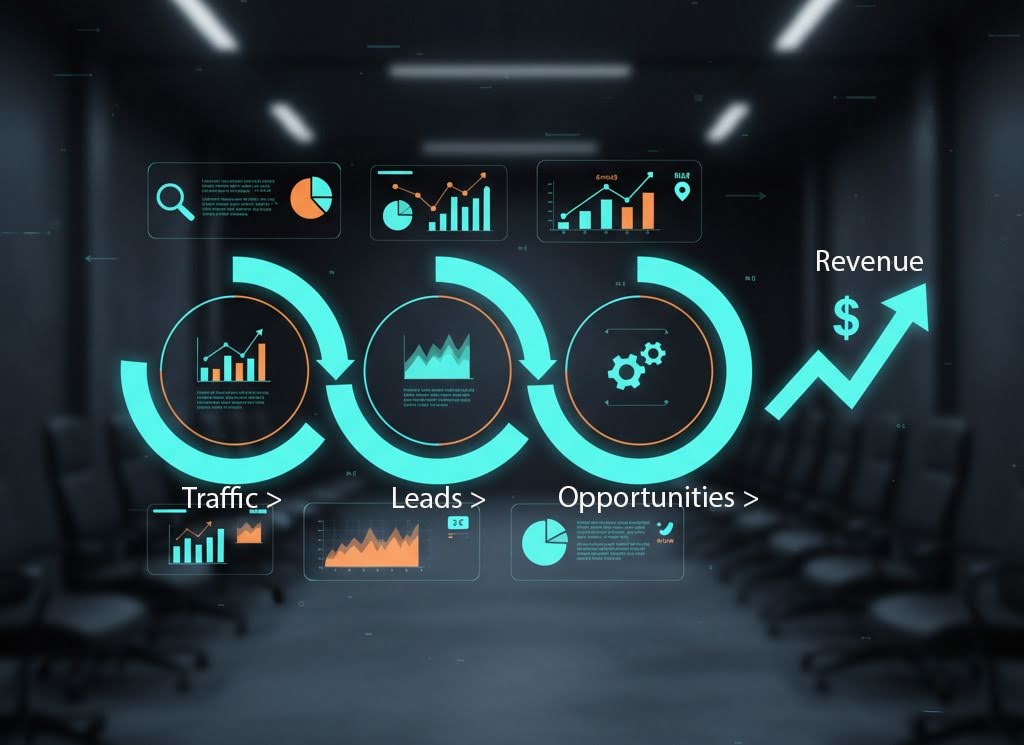
    When RevOps is properly put into practice, your entire funnel becomes much more predictable and efficient. Instead of a series of disconnected steps, you gain a system where:

    • Traffic from your optimized website and ad campaigns is clearly linked to leads.
    • Leads seamlessly connect to opportunities.
    • Opportunities directly translate into revenue.

    This transformation lets you move from constantly reacting to problems to proactively planning for growth. It also frees up your team to focus on what truly drives results, rather than chasing surface-level numbers.

    Bringing It All Together

    RevOps isn’t just a fad; it’s a fundamental shift in how modern businesses approach growth. By aligning your teams, connecting your data, and optimizing your processes, you gain the deep visibility needed to make smarter choices and truly maximize your marketing ROI. This holistic approach ensures every aspect of your digital strategy, from SEO to website design, contributes effectively.

    Without it, even your best campaigns might struggle because the underlying system isn’t built to support lasting growth.

    With RevOps, every part of your funnel works together, like a well-oiled machine, all focused on one clear goal: boosting your revenue.

    Your Next Step: Building a Unified Strategy

    Ready to stop guessing and start growing with confidence? A well-executed RevOps strategy is your blueprint for predictable revenue. Let’s explore how integrating your marketing, sales, and customer success can unlock your business’s full potential.

    Reach out to Lazarus Design Team today for a consultation on optimizing your digital presence and revenue operations.

  • 9 Web Design Trends That Improve Conversion Rates

    9 Web Design Trends That Improve Conversion Rates

    You’ve likely noticed the constant evolution of web design lately, a dynamic mix of bold visuals, innovative layouts, and interactive elements. Some designs are genuinely impressive. Others offer a glimpse into the future of digital presence. But for any business focused on tangible results, the central question remains:

    Do these captivating trends genuinely help transform visitors into loyal customers?

    Ultimately, a website is an indispensable growth engine for your business.

    The truly effective web design trends extend beyond mere aesthetics. They prioritize clarity, cultivate trust, ensure rapid performance, and skillfully guide users toward desired actions. 

    When executed thoughtfully, your website becomes a silent, always-on salesperson, diligently working to achieve your objectives. This is exactly what effective web design services are built to do.

    Let’s delve into 9 web design trends that are not just popular but unequivocally proven to elevate conversion rates.

    1. Clarity-First Design: Prioritizing Understanding Over Artistry

    For years, many brands aimed for distinction through abstract headlines, intricate layouts, and overtly creative phrasing. The fundamental issue with this approach is that users don’t wish to decipher puzzles. They seek immediate comprehension.

    Today, high-performing websites are shifting decisively toward a clarity-first design philosophy. This means a direct, transparent, and effortless user-friendly experience.

    What does this approach involve?

    • Straightforward headlines: These clearly articulate your core offering and the value you provide from the outset. No ambiguity, just direct communication.
    • Intuitive navigation: A streamlined digital pathway that minimizes user effort and friction, ensuring visitors can easily find what they need.
    • Clear visual hierarchy: Your design actively directs the user’s eye to the most critical information, ensuring key messages and calls to action are prominently featured.

    When a visitor lands on your homepage, they should be able to answer three essential questions within moments:

    • What exactly does this business offer?
    • Is this offering relevant to my needs or challenges?
    • What is the logical next step I should take?

    If your design fails to provide swift answers to these questions, you are likely losing potential conversions before the user even begins to explore further.

    2. Strategic White Space: Enhancing Focus and Readability

    Consider white space not as an empty area but as essential breathing room for your content. It’s no longer just an aesthetic preference; it’s a deliberate performance strategy.

    Cluttered layouts can overwhelm users. When every element competes for attention, nothing truly stands out. Conversely, intentional spacing helps users process information more efficiently and concentrate precisely on what matters most.

    High-converting websites leverage white space adeptly to:

    • Highlight key messages: By surrounding critical text or visuals with ample, clear space, you give them prominence, making them instantly noticeable.
    • Clearly separate sections: White space acts as a visual divider, organizing content into digestible blocks and improving overall page flow.
    • Make calls to action distinct: When a button or link is surrounded by sufficient clear space, it naturally becomes a focal point, encouraging engagement.

    This approach doesn’t result in a barren or uninteresting design. Rather, it cultivates elegance and efficiency, allowing your valuable content the space it needs to be absorbed and appreciated.

    3. Mobile-First Design: The Modern Standard, Not an Option

    web design trends

    This is no longer merely a trend; it is the fundamental standard for contemporary web design.

    A significant majority of users will interact with your site on a mobile device first. If this initial experience is cumbersome, slow, or difficult to navigate, they will promptly disengage.

    True mobile-first design transcends simple responsiveness. It embodies a commitment to prioritizing the mobile user experience from the very inception of your website’s development.

    What defines a robust mobile experience?

    • Simplified navigation: Designed with large, easily tappable elements and streamlined menus optimized for smaller screens.
    • Concise, scannable content: short paragraphs, bullet points, and clear headings are crucial for users on the go.
    • Key actions within thumb reach: Critical buttons and links are conveniently positioned for effortless interaction.
    • Rapid load times: Ensuring the site loads quickly, even on less-than-optimal network connections.

    Furthermore, Google actively prioritizes mobile performance in its search rankings. This means a superior mobile experience directly influences both your website’s traffic and its conversion capabilities.

    4. Speed-Driven Design: A Decisive Competitive Advantage

    Page speed is one of the most frequently overlooked yet profoundly impactful conversion factors.

    Extensive research, notably from Google, including its Core Web Vitals guidelines, consistently demonstrates that even a one-second delay in load time can significantly diminish conversions.

    Modern web design increasingly focuses on comprehensive performance optimization. This includes:

    • Lightweight design elements: Employing efficient code and graphics to maintain agility.
    • Optimized images and media: Ensuring all visual content is compressed for rapid loading without compromising quality.
    • Reduced reliance on heavy scripts: Minimizing code that can impede site speed.
    • Robust hosting and infrastructure: Utilizing fast, reliable hosting solutions built for optimal performance.

    A fast website does more than merely enhance user experience. It actively builds trust. Users implicitly associate speed with professionalism, reliability, and a business that values their time, a powerful psychological trigger for conversion.

    5. Conversion-Focused CTAs: Guiding with Intent and Value

    Not all calls to action are created equal.

    Generic buttons such as “Learn More” or “Submit” are being progressively replaced by more intentional, value-driven CTAs. These phrases speak directly to the benefit the user will receive by clicking, offering a clear promise rather than just an instruction.

    Consider the impact of phrases like:

    • “Get Your Free Flooring Estimate”
    • “Book Your Injury Assessment Today”
    • “Schedule Your Free Foundation Inspection”

    Beyond the wording, placement is equally vital. High-performing sites strategically position their CTAs:

    • A prominent primary CTA above the fold: This is your core call, immediately visible to new visitors.
    • Supporting CTAs integrated throughout the page: These act as progressive prompts as users engage with more content.
    • A compelling final CTA at the bottom: A powerful invitation for those who have fully absorbed your message.

    Each CTA is carefully aligned with the user’s current stage in their decision-making process, making the path to conversion feel intuitive and natural.

    6. Trust Signals: Architecting Credibility Directly into Design

    Trust is among the most significant drivers of conversion.

    However, simply adding a few testimonials or client logos is no longer sufficient. The way these elements are presented, their integration, visual context, and authenticity within your design, is paramount.

    Modern web design explicitly integrates trust directly into the user experience:

    • Clean, well-structured testimonial sections: Presenting genuine endorsements in a readable and credible format, perhaps with photos or industry affiliations.
    • Case studies with clear, verifiable results: Demonstrating your capabilities through tangible success stories, complete with data and compelling narratives.
    • Client logos strategically placed: Featuring recognized brands near key decision points instantly lends authority and social proof.
    • Subtle credibility cues throughout the page: This includes professional certifications, security badges, or a consistently polished design that communicates attention to detail.

    Users are continuously, subconsciously, evaluating whether they can trust your business. Your design should proactively affirm that trust before they even consciously formulate the question.

    7. Scannable Content Layouts: Designed for Real-World User Behavior

    It’s a well-established fact that people do not read websites word-for-word. They scan for relevant information, key points, and quick answers.

    This understanding is why effective content structure has become an indispensable component of intelligent web design. It’s about making your content easily digestible at a glance.

    What defines an effective, scannable content layout?

    • Clear, descriptive section headings: These act as navigational guides, allowing users to quickly locate topics of interest.
    • Short, concise paragraphs: Breaking up dense text into smaller, readable chunks improves comprehension and reduces visual fatigue.
    • Bullet points and numbered lists: Excellent for presenting complex information in an organized, easy-to-absorb format.
    • Visual breaks between sections: Images, icons, or simply ample white space provide visual relief and signal new content segments.

    This approach ensures users can efficiently find the information they need, keeping them engaged and progressing smoothly toward conversion.

    8. Subtle Interactions That Guide, Not Distract

    Animations and micro-interactions remain popular, but their application has evolved considerably.

    Instead of overtly flashy effects that can distract, high-converting sites employ subtle, purposeful interactions to gently guide user behavior and enrich the experience. These small details make the website feel responsive and intuitive.

    Consider interactions such as:

    • Hover effects: Visual changes on clickable elements (e.g., a button subtly changing color) provide instant, reassuring feedback.
    • Smooth transitions: Elegant fades or slides between page sections create a polished, seamless browsing experience.
    • Visual feedback on buttons and forms: A momentary ripple or highlight confirms that an action has been registered, boosting user confidence.

    The objective here is to ensure the entire user experience feels intuitive, responsive, and effortlessly engaging. These subtle cues act as helpful guides throughout the user journey.

    9. Data-Informed Design Decisions: The Catalyst for Measurable Results

    Perhaps one of the most significant shifts in contemporary web design occurs behind the scenes.

    Design decisions are no longer solely based on subjective opinion or aesthetic preference. They are increasingly anchored in empirical data.

    High-performing websites are continuously refined and optimized through:

    • Heatmaps: These visual tools reveal precisely where users click, scroll, and pause, offering invaluable insights into their behavior.
    • A/B testing: Systematically comparing two versions of a design element (e.g., a headline or CTA) to determine which performs better, ensuring continuous improvement.
    • Advanced analytics: Deep diving into user journeys, identifying conversion paths, and pinpointing areas for optimization.

    This means that the most effective web design trends aren’t just fleeting fashions. They represent validated patterns, consistently supported by real user behavior data, translating directly into tangible business outcomes.

    Bringing It All Together

    Ultimately, the most impactful web design trends aren’t about chasing novelty. They are about implementing strategies that consistently deliver results.

    Concepts like absolute clarity, rapid speed, unwavering trust, and intuitive usability might not be glamorous, but they form the essential foundation of every website that effectively converts visitors into valuable customers.

    If your website isn’t generating the desired outcomes, the challenge is rarely just insufficient traffic. More often, it stems from how that traffic experiences your site upon arrival.

    Your website’s design is a powerful instrument. It is either actively facilitating user action or, perhaps subtly, deterring it. The distinction is paramount.

    Many businesses struggle to translate design trends into actual conversions. At Lazarus Design Team, we specialize in building websites that don’t just look great but work even harder for your bottom line.

    Discover the difference a conversion-focused design makes. Contact the Lazarus Design Team for a Personalized Website Assessment.

  • Content Marketing Lead Generation: How to Build a Content Engine That Produces Leads

    Content Marketing Lead Generation: How to Build a Content Engine That Produces Leads

    Many businesses invest significant effort and resources into content marketing, only to find the results frustratingly inconsistent. You’re publishing blog posts, engaging on social media, and creating valuable resources, yet the direct link to actual leads often remains elusive. If this resonates, you’re in good company. The challenge isn’t a lack of effort; it’s a lack of a cohesive, well-engineered structure.

    Content marketing lead generation is about constructing a systematic approach that continuously attracts, nurtures, and transforms the right audience into qualified prospects. When executed with precision, your content evolves into a dependable growth channel across SEO, GEO (Generative Engine Optimization), and even paid distribution, delivering compounding returns over time.

    At Lazarus Design Team, we view content not as a series of isolated tactics but as a robust engine designed for sustained performance. Let’s explore how to build this engine, step by strategic step.

    What Defines Content Marketing Lead Generation?

    At its core, content marketing lead generation is the strategic application of valuable, relevant content to draw in potential customers through channels like organic search (SEO), generative search experiences (GEO), and paid campaigns, guiding them toward a specific action such as completing a form, scheduling a call, or requesting a detailed proposal.

    Companies operating with a documented content strategy are significantly more likely to achieve measurable ROI and generate higher-quality leads. The operative word here is strategy.

    Content merely existing doesn’t generate leads. Intent-driven content does. The crucial distinction lies in how meticulously your content addresses your audience’s specific needs and how clearly it directs them toward a logical next step.

    Why Do Many Content Strategies Fall Short of Generating Leads?

    Before we begin constructing our engine, it’s important to understand where things usually break down. Most content strategies falter for three primary reasons:

    1. Absence of Defined Audience Targeting: Content created to appeal to everyone inevitably resonates with no one. Without a precisely defined ideal customer, messaging becomes too diffuse to drive conversions.
    2. Disconnection from Search Intent: Businesses often produce content based on what they want to discuss, rather than what their audience is actively seeking. This fundamental misalignment results in poor visibility and minimal engagement.
    3. Lack of a Clear Conversion Path: Even when content successfully attracts traffic, there’s no defined next action for the reader. No explicit call to action (CTA), no strategic internal linking, no structured journey. A recent article from The New York Times discussed this very issue, noting that even high-quality content can fall short when it does not clearly guide the reader toward a next step. Without that direction, traffic alone rarely translates into meaningful business results.

    The predictable outcome? Traffic without tangible business results.

    A high-performing content engine addresses all three of these issues by seamlessly integrating strategy, execution, and conversion mechanisms.

    Step 1: Prioritize Search Intent Over Superficial Topics

    As search continues to evolve, content is no longer only competing for traditional rankings. Generative Engine Optimization (GEO) is becoming increasingly important, referring to how content is structured so it can be surfaced within AI-driven search experiences and assistants. In addition to SEO, this means creating content that is clear, well-organized, and directly answers user questions so it can be easily interpreted and referenced by these systems.

    If your main goal is lead generation, your content must directly align with the questions and problems your potential customers are actively searching for.

    Focus on these three critical types of search intent:

    • Informational Intent: Users are in the learning phase. Example: What is content marketing lead generation?
    • Commercial Investigation: Users are comparing solutions and options. For example, in the flooring industry, people are searching for terms like “best flooring marketing strategy” or “how to generate leads for a flooring business” as they evaluate different approaches and providers.
    • Transactional Intent: Users are poised to act. Example: content marketing agency services

    While a comprehensive content strategy will touch upon all three, lead generation is predominantly fueled by content addressing commercial and transactional intent.

    Instead of generic brainstorming, begin with thorough keyword research. Map your content directly to identified search intent. Tools like Google Search Console, SEMrush, or Ahrefs are invaluable for uncovering what your audience truly searches for and how competitive those topics are. This process not only strengthens your SEO performance but also helps your content surface in generative search results (GEO), where structured, intent-driven content is increasingly prioritized.

    This methodical approach ensures that every piece of content you create has inherent demand.

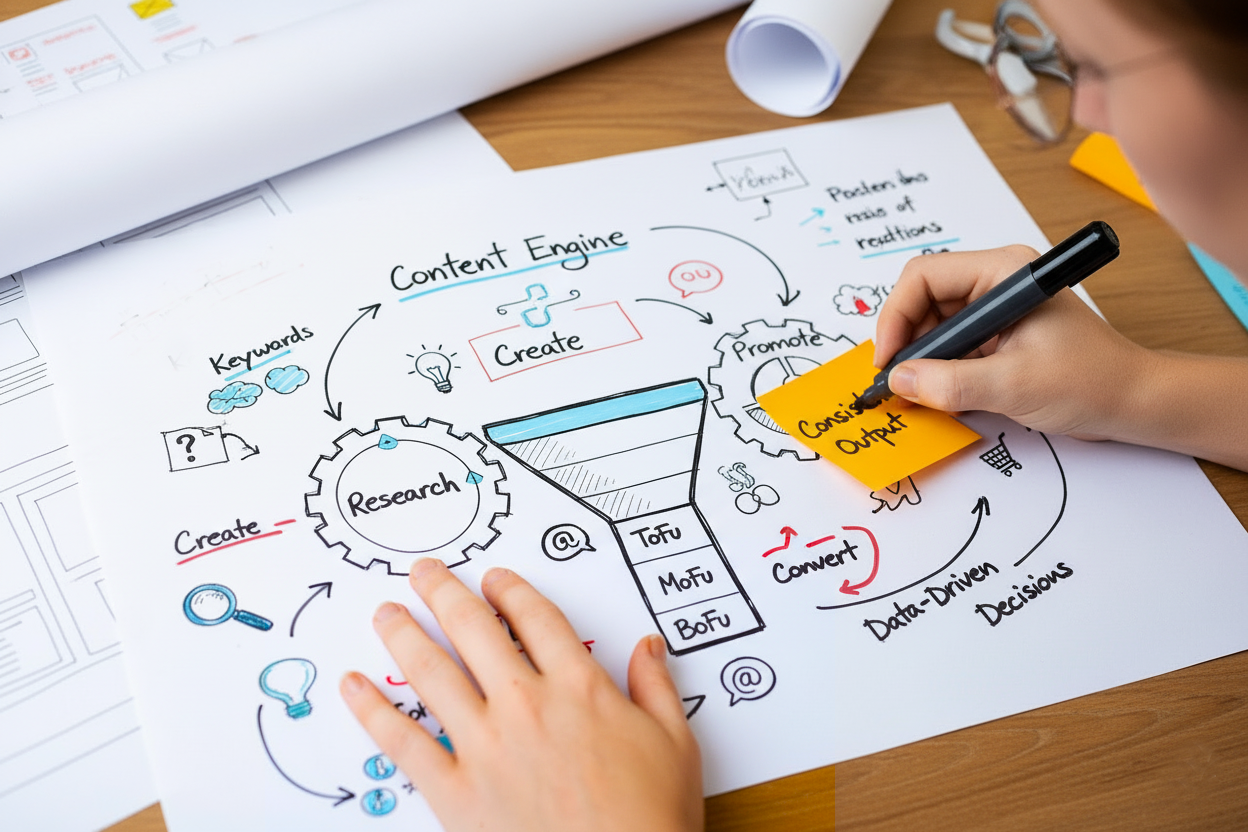
    Step 2: Build Content Around a Funnel, Not Just a Calendar

    Many brands rely solely on a content calendar. While consistency is undeniably important, strategic structure is paramount.

    Envision your content as a funnel, guiding prospects through their journey. This same structure can also support paid funnel conversions, where content is used in ads, landing pages, and retargeting campaigns to move users from awareness to action: 

    • Top of Funnel (ToFu): Educational blog posts and articles designed to attract broad traffic and address early-stage questions.
    • Middle of Funnel (MoFu): Detailed guides, comparative analyses, and compelling case studies that build trust and strategically position your brand as the optimal solution.
    • Bottom of Funnel (BoFu): Service pages, landing pages, and direct offers crafted to convert established interest into concrete action.

    Every piece of content you create should have a distinct role in propelling the user forward. For example, in the flooring industry, a blog post might introduce a topic like how to generate leads for a local flooring business. From there, the next step could be a more in-depth guide on marketing strategies, followed by a case study showing real results and ultimately leading to a service page or consultation offer.

    Without this thoughtful structure, content remains disconnected. With it, content becomes a precisely guided journey.

    Step 3: Craft High-Value, Conversion-Focused Content

    Not all content carries equal weight. To effectively generate leads, your content must transcend mere information; it must persuade and inspire action.

    Hallmarks of high-performing content include:

    • Clear Problem Definition: Demonstrate a profound understanding of the reader’s challenges and their implications.
    • Actionable Insights: Deliver genuine value that readers can practically apply, moving beyond superficial advice.
    • Strategic Structure: Employ clear headings, logical flow, and intuitive formatting to naturally guide the reader through the material while also making your content easier for search engines and generative AI systems (GEO) to interpret and surface.
    • Subtle Authority Signals: Integrate real-world experience, proven frameworks, or credible data to cultivate trust.
    • Designed Conversion Moments: Strategically place calls to action where they genuinely feel helpful and contextual, rather than intrusive.

    It’s crucial to strike a balance between depth and clarity. Overly complex content can overwhelm, and overly simplistic content feels generic. The objective is to educate comprehensively while simultaneously reinforcing confidence in your expertise.

    Step 4: Integrate Conversion Paths Directly Within Your Content

    If a reader consumes your content and subsequently takes no further action, a valuable opportunity has been missed.

    Every piece of content you publish should include a clear and logical next step. This is where CTAs, or calls to action, come in. A CTA is any prompt that encourages the user to take a specific next step, such as clicking a button, filling out a form, or exploring another page.

    Consider these effective conversion path examples:

    • Inline CTAs: Positioned naturally within the content at moments of high engagement.
      Example: In a flooring company blog, a line like “See how this flooring project increased home value” could link to a case study showcasing a completed installation.
    • End-of-Page CTAs: Designed for readers who have fully engaged with the content and are ready to move forward.
      Example: A physical therapy clinic might include a button that says “Schedule Your Evaluation” at the end of an article about injury recovery.
    • Content Upgrades: Downloadable resources directly tied to the topic, offering deeper value.
      Example: A home foundation repair company could offer a downloadable checklist like “Signs Your Foundation Needs Repair” within a blog about structural issues.
    • Internal Linking: Guiding users to related, high-intent pages or services.
      Example: A law firm writing about workplace injuries might link to a “Construction Accident Attorney” service page for readers ready to explore legal options.

    The key is alignment. The offer must precisely match the context of the content. If someone is reading about content marketing lead generation, a generic newsletter signup is a weak offer. A tailored strategy consultation or a content audit, however, is a much stronger next step.

    Good content informs. Great content converts.

    Step 5: Leverage SEO for Sustainable Lead Flow

    One of the most compelling advantages of content marketing is its compounding nature. Unlike paid advertising, which ceases to generate traffic the moment your budget pauses, SEO-driven content continues to attract visitors long after its initial publication.

    To maximize this enduring benefit:

    • Optimize for Primary and Supporting Keywords: Ensure your content rigorously aligns with actual search behavior.
    • Structure for Readability and Indexing: Utilize clear headings, strategic internal links, and intuitive formatting to aid both users and search engines.
    • Regularly Update Content: Refresh statistics, enhance sections, and keep your content perpetually relevant and valuable.
    • Build Topical Authority: Develop comprehensive clusters of related content around key themes, demonstrating your deep expertise.

    Search engines prioritize depth and relevance. The more robust and interconnected your content ecosystem, the stronger your visibility becomes, leading to a more consistent and reliable stream of leads.

    Step 6: Measure What Truly Matters for Lead Generation

    Not all metrics are created equal in the context of lead generation. While page views and impressions offer some insight, they rarely paint the complete picture.

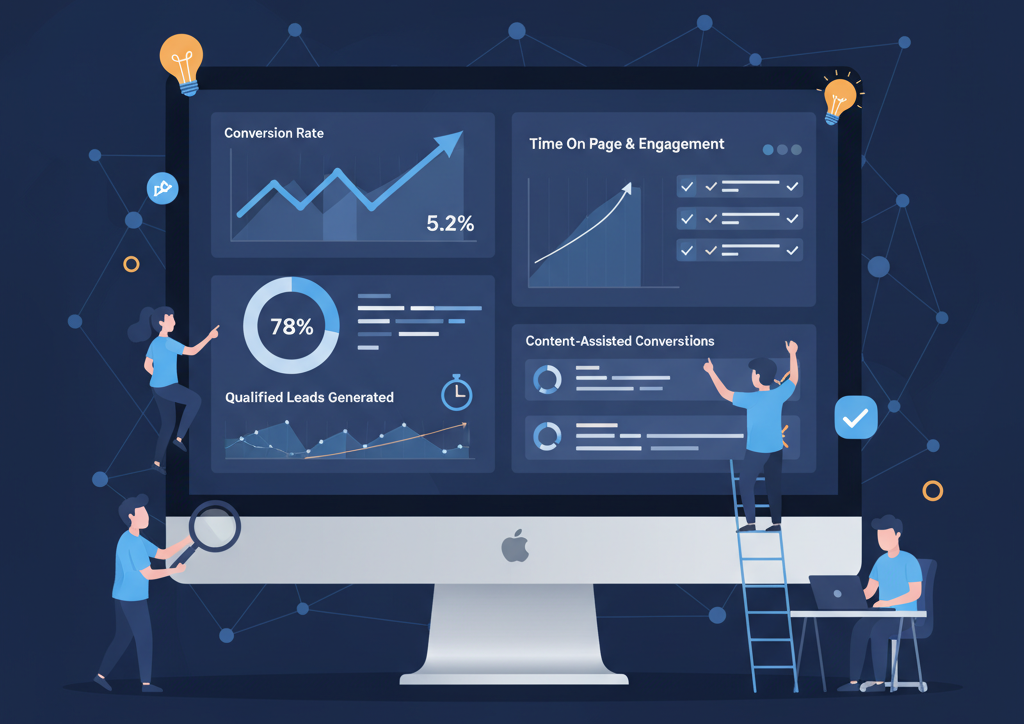
    To accurately assess if your content is generating leads across SEO, GEO, and paid funnel efforts, track the following:

    • Conversion Rate: The percentage of readers who take a desired action after engaging with your content.
    • Qualified Leads Generated: Beyond mere volume, focus on the relevance and fit of the leads generated.
    • Time on Page and Engagement: Are users truly consuming and interacting with your content?
    • Content-Assisted Conversions: Identify which pieces of content influence the buyer’s journey, even if they aren’t the final conversion point.

    This data provides the intelligence needed to amplify what’s working effectively and refine elements that aren’t performing as expected.

    Step 7: Transform Your Strategy into a Repeatable Engine

    Once you’ve validated your approach and identified what delivers results, the next critical step is scalability.

    A truly effective content engine is characterized by:

    • Systematic Processes: Clearly defined workflows for research, writing, optimization, and publication.
    • Consistent Output: Regular delivery of high-quality content without compromise.
    • Data-Driven Decisions: Strategies informed and refined by performance insights.
    • Alignment with Business Goals: Every piece of content actively supports your growth objectives, not merely visibility.

    Over time, this systematic approach builds powerful momentum. Instead of passively chasing leads, your content actively draws them to you, consistently and reliably.

    Engineering Your Active Growth Strategy

    Content marketing lead generation is not about chasing fleeting trends or seeking instant gratification. It’s about meticulously constructing a system designed for enduring performance. 

    When you intelligently align content with search intent, structure it purposefully around a conversion funnel, and engineer it to drive action, you create a system that performs across SEO, GEO, and paid channels, moving from passive publishing to active, measurable growth.

    The brands that consistently win in this landscape are not necessarily those producing the greatest volume of content. They are the ones that create the right content, in the right way, always offering a clear and compelling path forward for the user.

    If your current content efforts aren’t yielding the leads you anticipated, the fundamental issue is the strategy underpinning it.

    Ready to Build Your Content Engine?

    If you’re serious about transforming your content into a consistent, powerful lead generation channel, the most crucial next step is achieving absolute clarity.

    Ask for a 90-day content sprint plan. This will provide you with a focused, actionable roadmap specifically designed to attract, engage, and convert your ideal customers.

  • On Page SEO Service: The Anatomy of a High-Converting Service Page

    On Page SEO Service: The Anatomy of a High-Converting Service Page

    When you hear SEO, your mind probably jumps straight to keyword rankings and building backlinks. And sure, those metrics absolutely matter. But there is a massive piece of the puzzle that often gets overlooked. This piece decides whether your website traffic turns into actual paying customers. That missing piece is your service page.

    A well-crafted service page pulls double duty. It gives search engines a clear roadmap of what you do, while simultaneously helping potential clients decide if you are the right fit for their project.

    This is exactly why a dedicated on-page SEO service brings so much value to the table. It makes sure every single element of your page is doing its job to boost both visibility and conversions.

    At Lazarus Design Team, we run into this roadblock with clients all the time. A company will pour massive amounts of time and budget into driving traffic through SEO, paid ads, or social media, but the page catching all that traffic is not built to convert. When that happens, you are just letting valuable opportunities slip right through the cracks.

    Let us break down the anatomy of a truly effective service page and look at why on-page optimization is the secret ingredient to making it work.

    What is an on-page SEO service?

    So, what exactly goes into an on page seo service? At its core, it is the process of optimizing everything directly on your website so that both search engines and human readers know exactly what your content is about.

    Off-page SEO is all about building authority through external signals like backlinks. On-page SEO, on the other hand, rolls up its sleeves and gets to work on the actual content, layout, and usability of your website itself.

    A thorough and professional on-page SEO service page usually covers a few non-negotiable elements:

    • Deep-dive keyword research and search intent analysis
    • Smart, natural placement of keywords in your headings and body text
    • Title tags and meta descriptions written specifically to earn clicks
    • Internal linking strategies to create a solid site structure
    • Image optimization paired with descriptive alt text
    • Speed enhancements along with mobile-first adjustments

    Search engines like Google look at literally hundreds of different ranking factors. But some of the absolute strongest signals come straight from what is happening on your page. Google’s own documentation constantly pushes the need for logical structure, genuinely helpful content, and a seamless user experience.

    Simply put, a properly optimized page connects the dots. It helps both real people and search algorithms understand exactly what your business brings to the table and why it is important.

    Why Service Pages Matter More Than Blog Traffic

    We love a good blog post. Educational content is fantastic for building authority, answering common questions, and pulling in visitors who are just starting to research a topic.

    But let us be honest. Blog traffic on its own does not always equal a boost in revenue.

    Service pages are where the actual buying decisions happen.

    Think about this. When someone types in a specific request like website redesign, brand strategy, or digital marketing consulting, they are usually way past the early learning phase. Instead of casually researching a broad topic, they are actively comparing their options and evaluating potential providers to hire.

    In the marketing world, we call this high-intent traffic. These folks are not just curious. They have a problem, and they are looking for help.

    Because of this, a finely tuned service page needs to hit several major goals. It must rank well for high-intent keywords. It needs to clearly communicate the exact value of your service. It should proactively answer the questions and doubts sitting in the buyer’s mind. It must establish trust by showing real proof and experience. Finally, it must direct the visitor toward a clear next step.

    When all these moving parts click into place, your service page becomes one of the hardest-working conversion tools on your entire website.

    The Core Elements of a High-Converting Service Page

    A great service page is way more than a simple list of what you do. It is a carefully mapped out experience designed to take someone from mildly curious to totally confident.

    Here are the core components that help service pages perform incredibly well in both search results and lead generation.

    A Clear and Search-Optimized Headline

    Your headline is the first impression. It is the very first thing visitors and search engines notice, so it needs to announce exactly what is being offered without making anyone guess.

    Take a vague headline like “Our Services,” for example. A much stronger, conversion-focused alternative would be something like “Foundation Repair”, or “Crawlspace Waterproofing Services”.

    Weaving your primary keyword right into the main headline gives search engines a giant clue about the page topic while showing your human visitors they clicked the right link. Clear communication will always beat clever wording when your goal is to drive conversions.

    A Strong Introduction That Speaks to the Problem

    The moment someone lands on your page, your opening lines need to connect with the exact challenge they are dealing with.

    Within the first few seconds of a page load, a visitor is subconsciously asking three things. Am I in the right place? Do these people understand my problem? Can they help solve it?

    Your intro section needs to answer those questions with absolute confidence. If a business owner is frustrated because their current site gets traffic but zero leads, your service page needs to call out that exact frustration and explain how your process turns it around. When visitors feel truly understood, they are far more likely to keep reading.

    Well-Structured Content That Search Engines Can Understand

    Search engines lean heavily on how a page is formatted to figure out what it means. A logically organized service page relies on distinct heading tiers, organized sections, and digestible paragraphs.

    Proper structure typically includes a single primary headline, supporting subheadings to break up topics, short and readable paragraphs, and relevant keyword variations sprinkled naturally throughout the copy.

    This kind of formatting makes it incredibly easy for search engines to crawl the page efficiently. Just as importantly, it makes reading a breeze for your potential clients. People rarely read webpages word for word anymore. We scan until we find the specific info we care about. Clear headers make the scanning process effortless. A solid on page SEO service guarantees your page structure supports both search performance and the user experience.

    Trust Signals That Reduce Buyer Hesitation

    Hiring a new service provider feels risky to the buyer. It is only natural for them to want some reassurance before they pick up the phone or send an email.

    That is exactly why top-tier service pages are loaded with trust-building elements. These include genuine client testimonials, bite-sized case study highlights, years of industry experience, partnership badges or recognizable certifications, and a transparent look at how the service process works.

    Showing off these elements proves your credibility. It tells your prospect that your team has successfully solved this exact problem before. Knocking down that hesitation increases the chance that visitors will reach out.

    Internal Links That Support the User Journey

    Here is a piece of on-page optimization that gets ignored way too often. Smart internal links act like a tour guide, pointing your visitors toward other helpful resources on your site that deepen their understanding of what you do.

    A great service page might link out to educational blog articles, detailed case studies, related service pages, and helpful industry insights.

    These links keep visitors engaged with your content longer and help search engines map out the relationship between your pages. Over time, strong internal linking contributes to a healthier, more authoritative website architecture.

    Mobile Optimization and Page Performance

    How a page feels to use is a massive ranking factor today. Google has made it crystal clear that page experience metrics, like how well a site works on a phone and how fast it loads, directly influence how pages are evaluated.

    If your service page takes forever to load or feels clunky to navigate on a smartphone screen, you will lose that visitor in seconds. Fast load times and sleek mobile layouts remove friction, keeping your potential clients focused on your messaging instead of fighting with your website. Any on-page SEO service worth its salt is going to tackle these technical performance tweaks across all devices.

    Clear Calls to Action That Guide the Next Step

    Even the absolute best and most informative page will fail if it does not offer a clear path forward. Your visitors should never hit the bottom of your website and wonder what they are supposed to do next.

    High-converting service pages distribute highly visible calls to action strategically throughout the layout. You might see a primary call to action right near the top, contextual prompts tucked into key sections of the copy, and a final unmistakable call to action down at the bottom.

    These act as gentle nudges, inviting the reader to finally start a conversation with your team. At Lazarus Design Team, we are constantly reminding our clients that a service page is not just an informational flyer. It is an opportunity to begin a business relationship.

    content marketing lead generation

    Why Design and SEO Must Work Together

    One of the biggest mistakes a company can make is treating web design and SEO like they belong in separate silos. The truth is, these two disciplines are endlessly more effective when they are aligned right from the start.

    You can have a page that is flawlessly optimized on the backend for search engines, but if the design feels cluttered or confusing, people will bounce. Conversely, you can have a visually stunning masterpiece of a page that never ranks because it lacks the right structural foundation and keyword strategy.

    The absolute best service pages strike a perfect balance. They combine strategic keyword targeting with persuasive messaging. They use a thoughtful visual hierarchy that naturally draws the eye down the page. They employ a conversion-focused layout backed up by rock-solid internal linking and page structure.

    When these elements work together, you get a page that ranks well and makes people want to take action.

    Turning Service Pages into Growth Engines

    If you are looking at your analytics and seeing decent traffic but not generating the leads you expected, visibility probably is not the issue. The real problem is likely how your service page is communicating its value.

    A well-thought-out service page bridges the gap between a random search and a real business result. It establishes trust, showcases your expertise, and walks the visitor right up to the finish line.

    Over time, giving your service pages the attention they deserve turns them into massive digital assets. They pull in high-intent visitors, educate them on why you are the best choice, and help turn that initial interest into real business opportunities.

    At Lazarus Design Team, we specialize in building service pages that marry beautiful design, clear messaging, and elite SEO practices.

    Your service pages are working harder than you think, or maybe they are not working at all. Let’s find out which. Get a free service page audit, and uncover what is holding your conversions back.

  • SEO vs. Paid Search: What to Invest in First

    SEO vs. Paid Search: What to Invest in First

    Most businesses do not struggle because they chose the wrong digital marketing strategy. They struggle because they wait too long to choose one at all.

    At some point, nearly every business owner hits the same crossroads when planning growth. Should you invest in SEO for long term visibility, or put your budget into paid ads for faster results?

    Both paths offer the same golden prize. They get your business and its brand visible on Google. They both bring in traffic, generate leads, and ultimately drive revenue. But under the hood, they run on completely different engines. Deciding which one to fuel up first will have a massive impact on when you start seeing a return on your investment.

    Understanding how these two channels work and when each one makes sense can help you move forward with confidence instead of staying stuck in the debate.

    Here at Lazarus Design Team, we act as an extension of your own company, and this exact debate is one of the most frequent chats we have with business owners. The truth is that there is no one-size-fits-all answer. The smartest move always comes down to your unique timeline, your big picture growth goals, and the current stage of your business.

    Let us dive deep into the great debate of SEO vs paid search. We will explore how each powerhouse channel operates, what makes them unique, and exactly how you can figure out where to place your initial investment to get the best measurable results.

    Understanding the Real Difference Between SEO and Paid Search

    When you first look at them, SEO and paid ads might seem like two sides of the same coin. The goal for both strategies is to put your website directly in front of buyers who are actively searching for the exact solutions you offer.

    But the way they capture that attention is night and day.

    Search Engine Optimization, or SEO, is all about earning your spot organically. When a potential customer types a question related to your industry into Google, your website pops up simply because the search engine views your page as the most helpful, relevant, and trustworthy answer available.

    Earning those top organic spots is a beautiful blend of art and science. It requires multiple  moving parts working together perfectly. You need a fast and technically sound website. You need high-quality content that genuinely helps people. You need a strategy and plan with smart keyword targeting. You also need backlinks from other respected sites to prove your authority, along with a fantastic user experience that keeps visitors engaged.

    As time goes on, all these signals prove to Google that your business deserves the spotlight.

    On the flip side, paid search takes a much more direct route. Often called PPC (pay-per-click) or Google Ads, this strategy simply skips the line. Instead of slowly proving your worth to the algorithm, you pay for prime real estate right at the very top of the search results for specific keywords.

    Your success in the paid space relies on a completely different set of rules. Your daily budget and bidding strategy play a huge role. The relevance of your ads and your overall quality score matter just as much. Plus, the experience users have once they click through to your landing page will dictate how well those ads convert into paying customers.

    Paid search can flip the switch and bring visitors to your site very quickly. But there is a catch. In paid search, you are competing with other businesses primarily through budget. The companies willing to invest more often gain more visibility. The moment your ads stop running, the traffic stops as well.

    That right there is the fundamental difference between the two approaches. SEO builds a lasting digital footprint over time, while paid search buys you immediate visibility exactly when you need it.

    The Timeline Factor and Why Speed Matters

    When we talk about SEO vs paid search, time is usually the biggest deciding factor for our clients.

    Paid search is incredibly fast. You can build a campaign, write your copy, and launch it all in just a few days. Once those ads go live, your business can start seeing new website visitors in a short time. If you are in a tight spot and need leads right now, that kind of speed is an absolute lifesaver.

    Paid traffic works almost like a faucet. Once a campaign is live and Google has had some time to learn and optimize delivery, traffic can begin flowing much faster than most other marketing channels. But the moment you pause your budget, that flow stops. The visibility you were paying for disappears as quickly as it arrived.

    SEO operates on a completely different timeline. It demands patience, consistency, and a long-term mindset. Search engines need time to crawl your website, evaluate your content, and weigh your authority against competitors. With paid search, you are competing with the budget. With SEO, you are competing with expertise. One often rewards the deepest pockets, while the other rewards the most helpful and authoritative answer. In competitive markets, it can take several months before rankings begin to climb.

    The beauty of SEO is what happens once that traction kicks in. The growth compounds. A single piece of optimized content that ranks on the first page can bring in hundreds of targeted visitors every single month. And it can do that for years without you paying a single dime for those clicks.

    To put it simply, paid search gives you that quick win today, while SEO builds the unstoppable momentum you need for tomorrow.

    Renting Digital Space vs Building a Real Asset

    Another massive difference between SEO and paid search is how you spend your marketing dollars over time.

    With paid search campaigns, you pay a fee every single time someone clicks on your ad. Depending on your specific industry and how badly your competitors want that same click, the cost can be very high.

    When you run ads, you are basically renting attention from Google. It is a fantastic short-term lease. Your brand stays highly visible as long as you keep paying the rent. But the moment you decide to cut the budget, your presence vanishes from the top of the page.

    SEO takes a much more foundational approach. It requires a solid upfront investment in strategy, technical web development, and ongoing content creation. Yes, this takes resources and hard work at the beginning. But what you are really doing is building a permanent digital asset for your business.

    Once your website starts dominating the organic rankings, the traffic it brings in does not cost you anything per click. If ten people visit your site or ten thousand people visit your site, your cost remains the same.

    This compounding return on investment is exactly why SEO eventually becomes the most cost-effective way to acquire new customers. Paid search lets you buy your way to the top today, but SEO builds a self-sustaining revenue engine for the future.

    Visibility and Trust in the Search Results

    There is a psychological element to this debate that a lot of business owners completely overlook. It comes down to how real human beings view the search results.

    When someone goes to Google looking for a new service provider, they see a mix of sponsored ads and organic links. Even though the ads are positioned right at the top, a huge percentage of people will naturally scroll right past them to click on the organic results below.

    Why do people do this?

    It all comes down to trust. People are smart. They know that the organic spots were earned through merit and quality, not just bought with a large marketing budget. Because of this, companies that rank high organically enjoy a massive boost in instant credibility. The searcher assumes you are the best in the business simply because Google put you there naturally.

    Now, this does not mean paid search is a waste of time. Ads still capture a massive number of high-intent clicks from people who are ready to buy right then and there.

    But the real magic happens when you show up in both places. If a potential client sees your ad at the top and then sees your website again in the organic results a few seconds later, you suddenly dominate their screen. That double exposure reinforces your brand authority and makes it incredibly likely that they will click on your site instead of your competitors.

    How Paid Ads Accelerate Your Learning and Data

    One massive advantage of running paid search that we love to utilize is the pure speed of data collection.

    When you launch a Google Ads campaign, performance insights begin to appear fairly quickly. Although Google’s system needs a short learning period to optimize bidding and targeting, you can soon start seeing which keywords generate traffic, which ad headlines attract clicks, and which landing pages convert those visitors into paying clients.

    This creates a rapid feedback loop. You get hard numbers in a matter of weeks instead of waiting months to see if an SEO strategy is paying off.

    The smartest marketing teams use this exact paid data to fuel their long-term SEO strategy. If you notice that a specific group of keywords is consistently driving cheap conversions in your ad account, those are the exact topics you should target with your organic content.

    Using ads as a testing ground takes a bit of  the guesswork out of your marketing. It ensures that when you finally invest time and money into ranking organically, you are doing it for keywords that you already know will make you money.

    When Paid Search Should Be Your First Move

    There are times when firing up a paid search campaign is the smartest first step for your business.

    If you need leads right away to keep the lights on, paid search is your best friend. It delivers results incredibly fast. This is especially vital for brand new startups or companies trying to break into a highly competitive market where the big players already dominate the organic space.

    Paid search is also perfect when you are launching a new product or service. You can instantly push your new offering right in front of your ideal buyers while your long-term organic presence is still baking in the oven.

    If you just launched a new website, it is going to take time to build up your domain authority. Paid ads bridge that gap. They give you the visibility and potential cash flow you need to survive while your SEO efforts slowly gain traction in the background.

    Finally, paid ads are the ultimate testing tool. They let you experiment with different sales pitches, special offers, and landing page designs to see what your audience responds to.

    In all these scenarios, paid search acts as pure rocket fuel for your business growth.

    When SEO Should Be Your Top Priority

    On the flip side, focusing heavily on SEO from day one is often the best path for companies looking at the bigger picture.

    If sustainable growth is your goal, you need organic traffic. It provides a steady and reliable stream of leads that does not vanish the second you lower your marketing budget.

    You also must look at the cost of advertising in your specific industry. In some B2B fields, the cost per click is just outrageously high. If you are paying a very high price just to get someone to click your link, investing that same money into ranking organically will drastically lower your customer acquisition costs over time.

    SEO is also essential if your service requires a lot of education. If you sell complex services or high-ticket items, people rarely buy on impulse. They need to research, read, and build trust before they pull out their credit card. A strong SEO content strategy lets you answer their questions and guide them smoothly through the buying journey.

    Ranking for these educational topics does something else, too. It positions your business and its brand as a true industry leader and a helpful resource, rather than just another company shouting for attention with an ad.

    In these cases, SEO becomes the absolute bedrock of your demand generation strategy.

    Why the Most Powerful Growth Strategy Combines Both

    The whole conversation surrounding SEO vs paid search almost always treats them like bitter rivals. People think they must pick a side.

    But the reality is that the most successful companies out there do not choose. They combine them.

    Paid search gives you that instant visibility and incredible market data. SEO builds your long-term brand authority and secures a sustainable flow of traffic. When you put them together, they make each other stronger.

    You can use your quick paid campaigns to find the most profitable keywords and then hand those keywords over to your SEO team to build lasting content around. At the same time, the high-quality content you create for SEO can be used as landing pages for your paid ads. Better content means a better user experience, which lowers your ad costs and boosts your conversion rates.

    Plus, showing up in both the paid and organic sections of Google tells the searcher that you are the undisputed leader in your space.

    Instead of looking at them as competing options, you should view SEO and paid search as two gears working together in a much larger revenue engine.

    Step 7: Rebuild & Protect SEO Foundations

    Pay close attention to this step. This is the exact phase where poorly managed redesigns unintentionally wipe out years of hard-earned organic search growth overnight.

    Before you even think about launching the new site, you must conduct a thorough, meticulous SEO and keyword audit of your current site. You need to identify exactly which pages are currently driving your most valuable organic traffic and conversions. Whenever humanly possible, you must preserve these high-performing URLs exactly as they are.

    If your URL structures absolutely must change, you must create a comprehensive 301 redirect map. One failed migration can instantly dissolve all your hard-earned backlinks, deeply confuse search engines, and tank your rankings. We have seen businesses come to us after losing 80% of their organic traffic simply because a previous developer decided to skip this crucial step.

    As you migrate content, ensure you update your title tags, meta descriptions, image alt text, and heading structures to reflect the most current SEO best practices. Maintain a strict, logical H1-H2-H3 hierarchy across all your pages to make scanning easy for both human readers and search engine crawlers.

    A new website should act as a multiplier for your existing SEO performance; it should never reset your progress back to zero.

    How to Decide Where to Put Your Money First

    If you are still trying to figure out where to start your journey, sitting down and asking yourself three simple questions can usually clear things up.

    First, how quickly do you absolutely need to see a return on your investment? If speed is the priority, paid search is where you need to begin.

    Second, what do your long-term growth goals look like? If you want to build a resilient business with a durable source of incoming leads, SEO simply must be part of your foundation.

    Third, what kind of resources are you working with right now? SEO requires a commitment to creating great content and optimizing your site over months. Paid search requires a healthy and ongoing advertising budget to keep the clicks rolling in.

    Your honest answers to these questions will point you in the right direction.

    Bringing It All Together for Your Business

    The great debate of SEO vs paid search is never about figuring out which channel is inherently better. It is entirely about understanding how each strategy supports a different phase of your business growth.

    Paid search brings you speed, rapid testing, and visibility exactly when you need it. SEO builds deep trust, unwavering authority, and a traffic source that lasts for years.

    The companies that experience the most explosive growth understand this completely. They know that a truly healthy digital marketing strategy requires a careful balance between creating short-term cash flow and building long-term digital equity.

    Not sure whether SEO or paid search should come first for your business? The right answer depends on your goals, your timeline, and how your market works. That’s where Lazarus comes in. We don’t make you choose. We help you build both as one integrated strategy. One team managing your paid visibility while your organic authority compounds in the background. No handoff, no gaps, no guesswork. Reach out to our team to start a conversation about the best path forward for your business.

  • Website Redesign Checklist: What to Fix First

    Website Redesign Checklist: What to Fix First

    Let’s be completely frank, most website redesigns are doomed to fail long before the first wireframe is even drawn or the initial mockup gets approved.

    It’s not because the design itself lacks creativity. It’s rare because your web developer forgot a line of code.

    The real reason is that teams tend to get completely swept up in aesthetics, the sleek layouts, the fresh colors, the trendy fonts, while completely ignoring the underlying mechanics that drive revenue.

    Here is the hard truth: a gorgeous new color palette won’t fix a leaky sales funnel. A trendy, modern typeface won’t make up for confusing, jargon-heavy copy. And a beautifully animated homepage is virtually useless if weak SEO and a frustrating user experience are driving your ideal clients straight to your competitors.

    A successful redesign isn’t just an art project; it is a highly strategic business move. The absolute best websites are born from a perfect balance of art and science. They seamlessly blend performance data, conversion psychology, technical health, crystal-clear messaging, and a frictionless user experience. When you get all those moving parts working together, your website stops being a static digital brochure and becomes a powerful, 24/7 engine for measurable growth.

    Without a structured, data-driven website redesign checklist, businesses routinely waste tens of thousands of dollars just refreshing the surface. They leave the deep, structural friction completely untouched. The unfortunate result is a site that gets plenty of compliments from your colleagues but wildly underperforms where it actually matters: your bottom line.

    This guide will walk you through a prioritized, step-by-step website redesign checklist. 

    We are starting with the foundational elements that have the biggest impact on your ROI, your organic search visibility, and your user experience. If you’re going to invest your valuable time and budget into a redesign, let’s make sure you are fixing the right things first.

    Step 1: Clarify Business Goals Before Touching Design

    Before anyone on your team opens Figma, starts pinning ideas to a mood board, or sketches out a single layout, you need absolute, unwavering strategic clarity.

    Ask yourself:

    • What is this website supposed to do for my business?
    • Are you trying to generate high-ticket B2B leads?
    • Are you looking to drive a high volume of e-commerce transactions?
    • Is the main goal to book consultations or software demos?
    • Are you trying to establish industry authority and thought leadership in a fiercely competitive space?

    Your redesign must be tied to a primary business objective. If it isn’t, you are essentially designing in the dark, hoping for the best.

    Once you know the primary goal, you need to define the specific conversion actions that fuel your growth.

    What does a win look like:

    • Completed form submissions.
    • Direct phone calls to your sales team
    • Demo requests or calendar bookings
    • Direct product purchases
    • High-value resource downloads (like whitepapers, checklists, or comprehensive guides)

    Next, it’s time to step away from the design inspiration galleries and dig into your analytics (like Google Analytics 4):

    • Where is your current traffic coming from?
    • Which marketing channels are delivering your highest-quality leads?
    • Which pages boast strong user engagement, and which ones suffer from alarming bounce rates?
    • Most importantly: Where exactly are users abandoning your site right before they convert?

    True digital strategy begins right here, with hard, undeniable data.

    Use this discovery phase to refine your audience personas:

    • Who is visiting your site?
    • What immediate pain points are they trying to alleviate?
    • What hesitations or objections will they have before handing over their money?
    • And what specific trust signals do they need to see to feel confident?

    Finally, before a single line of code is rewritten, establish your measurable KPIs (Key Performance Indicators). If you don’t document your current baseline metrics, you will never truly know if the new site was a success. Business alignment must dictate the design.

    SEO Strategy Tip: This is the perfect moment to ensure your target keyword strategy directly mirrors your highest-margin products or services. You can rank beautifully for a hundred different search terms, but if they are the wrong terms, that traffic will never translate into real revenue.

    Step 2: Fix Messaging Before Visual Design

    Great design can elevate your message, but it absolutely cannot create clarity out of chaos.

    If your core messaging is vague, overly complicated, or trying too hard to be clever, no amount of smooth scroll animations or layout tweaks will save your conversion rate.

    We highly recommend putting your current homepage to the five-second test. When a brand-new visitor lands on your site, can they immediately understand:

    1. What exactly do you do?
    2. Who do you specifically serve?
    3. Why does it actually matter to them?

    If the answer isn’t an immediate, resounding “Yes,” your copy needs a serious overhaul. Think of your website like a conversation at a crowded networking event. If you spend the first five minutes talking in circles about synergy and shifting paradigms, the person you’re talking to is going to politely excuse themselves and walk away. Your website visitors will do the same thing, just much faster.

    Your core value proposition needs to be painfully obvious above the fold, the area visible before the user even scrolls. Your visitors should instantly see how you are going to solve their problem.

    Evaluate your current copy by asking yourself these critical questions:

    • Does it focus heavily on the outcomes the client receives, rather than just rattling off a list of your features?
    • Does it clearly and confidently differentiate you from your biggest competitors?
    • Does it speak directly, with empathy, to your ideal client’s biggest frustrations?
    • Is the tone conversational and perfectly aligned with your authentic brand voice?

    Strong, high-converting messaging typically follows a proven structure:

    • A clarity-first H1 headline: Tell them exactly what you do without the fluff.
    • A supportive H2 sub headline: Expand on the specific benefit, promise, or outcome.
    • Empathetic, audience-centric language: You should be using the word “You” far more often than you use “We” or “I.”
    • Benefit-driven paragraphs: Keep them short and easy to skim. No walls of text.
    • Clear, action-oriented calls to action (CTAs): Tell them exactly what to do next.

    Remember: clarity will consistently outperform cleverness. In many of the redesign projects we handle as an agency, refining the messaging and positioning alone can drastically increase conversion rates, sometimes before we’ve even touched the visual layout.

    Step 3: Repair Site Structure & Navigation

    Using your website’s navigation should feel completely effortless.

    In the digital world, a confused mind always says “no.” If a user must stop, pause, and actively think about where they are supposed to click next to find what they need, you’ve introduced friction. And friction is the ultimate conversion killer.

    Start this phase by auditing your entire current sitemap.

    Map out every single page that exists on your domain. Identify what is outdated, redundant, or offering thin value. Over the years, it is incredibly common for websites to accumulate digital clutter like old blog posts that no longer reflect your current expertise, duplicate service pages, or forgotten landing pages from campaigns run three years ago.

    Simplify ruthlessly wherever you can.

    As a rule of thumb, your main navigation menu should feature no more than five to seven core items. Anything beyond that creates cognitive overload for the user. Each menu item should represent a highly logical, intuitive step in your buyer’s journey. Organize your content into a clean hierarchy that naturally guides visitors from the awareness stage, through the consideration phase, and straight into a confident decision. A visitor should never, ever feel lost on your website.

    From an SEO perspective, clean site architecture is absolutely vital.

    It allows search engine bots to crawl, understand, and index your content efficiently. When you organize your site into well-structured keyword clusters, you signal strong topical authority to search engines. Furthermore, a strategic internal linking strategy naturally increases the time users spend on your site, which sends massive positive engagement signals back to Google.

    From a user experience standpoint, simplicity immediately builds trust. Navigation should be completely intuitive, predictable, and seamless.

    Step 4: Optimize for Conversions

    A beautiful website gets compliments, and a bulletproof conversion strategy generates revenue.

    As a non-negotiable part of your website redesign checklist, you need to audit every single call to action (CTA) currently on your site:

    • Are your CTAs abundantly clear? (e.g., Get a Free Quote instead of Submit)
    • Do they stand out visually, utilizing a contrasting brand color that draws the eye?
    • Are they placed strategically throughout the user’s reading journey?

    High-performing, growth-focused websites utilize layered CTA placement:

    • A primary CTA in the hero section: Right at the top (e.g., Schedule a Consultation).
    • Contextual CTAs mid-page: Placed naturally where a user might be convinced (e.g., See How We Helped This Brand to Achieve this Result).
    • A final reinforcement CTA: Anchored near the bottom of the page for users who took the time to read the whole thing (e.g., Ready to Transform Your Website? Request a Redesign Roadmap Session).

    Next, critically evaluate your contact and lead capture forms.

    Are you demanding a phone number, company size, annual revenue, and a street address when a simple email address would suffice?

    Every single extra field you add to a form drastically increases friction and drops your completion rate. Only ask for the information you absolutely must have to start the conversation.

    Furthermore, remember that people only buy from brands they trust. You need to inject trust-building elements exactly where users are experiencing friction or deciding:

    • Real, relatable client testimonials
    • Authentic video reviews
    • In-depth case studies that highlight measurable ROI
    • Recognizable logos of clients or partners you’ve worked with
    • Industry certifications, security badges, or notable awards

    Finally, don’t ignore the not-quite-ready crowd. You must offer secondary, lower-commitment CTAs for the visitors who are still in the research phase. Not everyone who lands on your site is prepared to whip out their credit card or request a sales quote today. Some visitors may just want to read a case study, subscribe to an insightful newsletter, or download a definitive guide to solve a minor problem first. Give them a way to enter your ecosystem.

    Conversion optimization is the vital bridge that transforms casual, anonymous visitors into qualified, eager leads.

    Step 5: Improve Technical & Performance Issues

    You can have the best copy and the most stunning design in the world, but if your site runs poorly, you will lose. Performance is a massive component of the user experience.

    A slow, clunky website quietly erodes trust and drains your potential revenue by the second. Studies consistently show that even a mere one-second delay in page load time can drastically increase bounce rates. If your site takes more than three seconds to load, your potential customer isn’t waiting around; they are hitting the back button and clicking on your competitor’s link.

    Your redesign must prioritize the underlying technical mechanics:

    • Page speed optimization: Upgrading your hosting environment, utilizing proper caching, and stripping out bloated, unnecessary code.
    • Mobile-first responsive: Ensuring the site functions flawlessly on the exact devices your audience uses most.
    • Properly sized touch targets: Guaranteeing that buttons and links are comfortably easy to tap on a smartphone screen.
    • Modern image formatting: Compressing media and serving images in next-gen formats (like WebP).
    • Core Web Vitals: Mastering Google’s specific metrics for speed, interactivity, and visual stability (LCP, INP, CLS).
    • Link health: Fixing all broken links and untangling messy, endless redirect chains.
    • Security: Enforcing strict HTTPS and maintaining valid SSL certificates to protect user data.
    • Accessibility: Ensuring foundational ADA/WCAG compliance so that all users, regardless of ability, can easily navigate and use your site.

    Google openly and aggressively prioritizes technically sound websites. In the era of mobile-first indexing, the mobile version of your site is the primary version search engines evaluate. Speed, mobile responsiveness, and technical integrity are mandatory safeguards for your business growth.


    Step 6: Update Visual Identity Strategically

    Now, and only now, does visual design take center stage.

    Modern typography, intentional whitespace, a color palette that stays true to your brand, and high-quality imagery all work together to elevate the user experience. But you must remember the golden rule of web design: the art must support the core message.

    • Modernize typography: Choose crisp, highly legible, web-safe fonts that accurately reflect your brand’s unique personality.
    • Improve whitespace and layout: Use negative space strategically to give your content room to breathe and to naturally guide the user’s eye directly toward your most important copy and CTAs.
    • Align visuals with brand identity: Ensure that your color palettes, graphics, and design motifs remain consistent with your established brand guidelines across every single page.
    • Upgrade imagery: Invest in custom photography of your actual team, tailored illustrations, or high-quality, professional graphics.
    • Enhance visual accessibility: Always double-check color contrast ratios, proper font sizing, and visual hierarchy to ensure ultimate readability for everyone.

    Design is inherently psychological. It should feel effortless, naturally pulling the user’s eye toward clarity and action. If a specific visual element, like a chaotic background video or an overly complex animation, competes with your messaging instead of reinforcing it, cut it out immediately.

    Truly great design doesn’t just look pretty. It actively amplifies your business strategy.

    Step 7: Rebuild & Protect SEO Foundations

    Pay close attention to this step. This is the exact phase where poorly managed redesigns unintentionally wipe out years of hard-earned organic search growth overnight.

    Before you even think about launching the new site, you must conduct a thorough, meticulous SEO and keyword audit of your current site. You need to identify exactly which pages are currently driving your most valuable organic traffic and conversions. Whenever humanly possible, you must preserve these high-performing URLs exactly as they are.

    If your URL structures absolutely must change, you must create a comprehensive 301 redirect map. One failed migration can instantly dissolve all your hard-earned backlinks, deeply confuse search engines, and tank your rankings. We have seen businesses come to us after losing 80% of their organic traffic simply because a previous developer decided to skip this crucial step.

    As you migrate content, ensure you update your title tags, meta descriptions, image alt text, and heading structures to reflect the most current SEO best practices. Maintain a strict, logical H1-H2-H3 hierarchy across all your pages to make scanning easy for both human readers and search engine crawlers.

    A new website should act as a multiplier for your existing SEO performance; it should never reset your progress back to zero.

    Step 8: Test Before Launch

    A website is never truly finished. It is a living, breathing digital asset that should continually evolve right alongside your business.

    Before hitting the final go-live button, you need to test the site rigorously. Check it across multiple browsers (Chrome, Safari, Firefox, Edge) and across various devices (iOS, Android, desktop, tablet).

    Don’t assume things work just because they look right. Submit every single contact form to ensure the leads route to the correct inbox. Click on every single CTA button. Verify that all your third-party integrations, your CRM system, your email marketing software, your booking calendars, and your payment gateways are communicating flawlessly.

    Ensure that your tracking is perfectly dialed in. Google Analytics 4 (GA4) and Google Tag Manager must be firing correctly before the launch, not after.

    And once the site goes live, don’t just pop the champagne and walk away. Monitor your site’s performance daily for at least the first two weeks. Watch your analytics data closely. Keep an eye on Google Search Console to catch any sudden 404 crawl errors. Gathering this initial data will allow you to quickly pivot, begin A/B testing, and continuously refine your conversion performance over time.

    Launch day isn’t the finish line. It is day one of optimization.

    Common Redesign Mistakes to Avoid

    Many redesign failures stem from highly predictable, entirely avoidable mistakes. As you move forward, make sure your team isn’t:

    • Chasing fleeting, flashy design trends instead of prioritizing long-term, intuitive usability.
    • Ignoring historical site data and making massive UX decisions based purely on subjective gut feelings.
    • Treating the website like an abstract art project rather than a measurable sales tool.
    • Treating SEO as an afterthought to be tacked on post-launch.
    • Failing to map out and test user journeys, thereby missing incredibly obvious friction points.
    • Forgetting to migrate essential tracking codes, analytics tags, and conversion pixels.

    The biggest mistake of all is spending your entire budget fixing what looks broken on the surface, while completely ignoring the structural and strategic mechanics that are broken underneath.

    What to Fix First: Order of Impact

    If you’re staring down the barrel of a massive project scope and feeling overwhelmed about where to begin, take a breath. Prioritize your team’s efforts in this exact order:

    1. Business goals & audience alignment
    2. Messaging clarity & value proposition
    3. Site structure & user journey
    4. Conversion optimization
    5. Technical performance & hosting
    6. Visual refinement & brand identity
    7. SEO preservation & redirect mapping
    8. QA testing & data tracking

    The highest-ROI redesigns always, without exception, solve strategic business problems first and visual problems second.

    Bringing It All Together

    A website redesign checklist is a blueprint for making your digital presence perform at its absolute peak.

    When you seamlessly combine the art of beautiful, custom, empathetic design with the hard, undeniable science of conversion strategy and SEO, your website transforms. It stops being a static, hidden digital brochure and steps up to become a highly scalable, 24/7 revenue-generating asset for your brand.

    Strategy first. Design second. Growth always.

    Ready to Fix the Right Things First?

    If you’re planning a redesign, don’t start by arguing over which shade of blue looks best on the homepage. Start with absolute clarity.

    You need to partner with an agency that acts as a team that intimately understands how to balance beautiful, engaging design with measurable, bottom-line business growth. Request a Redesign Roadmap Session

    We’ll audit your current site, uncover those hidden friction points that are costing you leads, and show you exactly what to prioritize to ensure a measurable return on your investment. Let’s collaborate to build a digital experience that captures your audience’s attention and fuels serious, long-term growth for your business.